
Your store should improve itself while you sleep
Most online stores are at their best on launch day and slowly decay after it, but the next generation will find where shoppers drop off and fix it every day, with the merchant setting the rules instead of doing the work.
Every online store is at its best on launch day.
The photos are fresh. The copy was argued over line by line. Someone checked every page on their phone. Then the store goes live, and the slow decay begins.
A new product goes up with the supplier’s description because the launch is late. A banner for a sale that ended three weeks ago is still at the top of the homepage. A new app pushes the reviews below the point where most shoppers stop scrolling. The hero image that looks great on a laptop crops the product out on a phone. Every new script makes the pages a little slower. The size guide is still right for last season’s range.
Nobody decides to let their store decay. It happens one reasonable shortcut at a time, and it happens to almost everyone.
The saw blade
The industry’s answer to decay is the redesign. Every couple of years the store gets bad enough that someone commissions a new one. There’s a project, a launch, a burst of improvement. Then the decay starts again.
Plot it over time and you get a saw blade: sharp climbs, followed by long, slow slides.
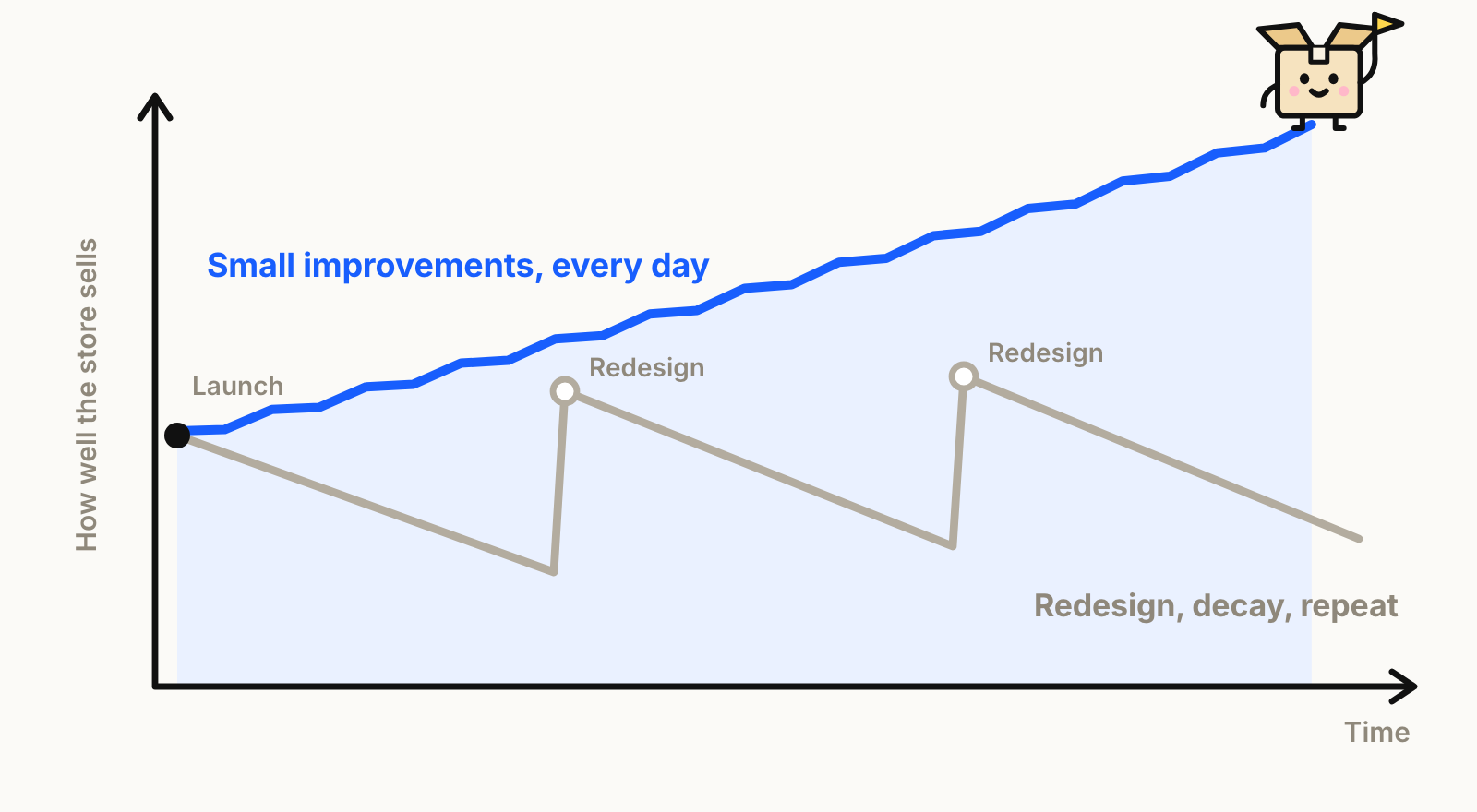
The saw blade is expensive in two ways. The obvious cost is the redesign itself. The less obvious one is the time spent on the slide: months of a store that’s quietly converting worse than it could, losing a little revenue from every visitor while problems pile up waiting for the next big project.
The alternative is the other line on that chart. No big jumps, just a store that gets slightly better almost every day. Manufacturers have had a name for this for decades. Toyota made it famous as kaizen: continuous improvement through many small changes, made by the people closest to the work.
Online stores have never really been able to work that way, and the reason has less to do with technology than with economics.
Why stores couldn’t improve themselves before
Think about what a single small improvement used to cost.
Someone had to notice the problem, which meant digging through analytics or watching session recordings. Someone had to work out why shoppers were leaving. Someone had to design a fix, someone else had to build it, and someone had to check whether it helped. For a large retailer with a team for each of those steps, that’s routine. For a small brand it’s a week of the founder’s time, or an agency invoice, for a change that might move conversion by a fraction of a percent.
When each change costs more than it’s worth, you stop making changes one at a time and batch them into a redesign. The saw blade is simply what improvement looks like when improvement is expensive.
AI changes the price of a single improvement. Spotting the problem, diagnosing it, drafting the fix and publishing it can now happen in minutes, without a project. And once improvements are cheap, it finally makes sense to make lots of small ones.
What a self-improving store actually does
A store that improves itself runs one loop, over and over:
- Watch. See how shoppers really move through each page: where they slow down, where they stop scrolling, where they leave.
- Diagnose. Work out why. Are the reviews below the point where most people give up? Does the headline match what the ad promised? Is the button lost on a small screen?
- Propose. Turn the diagnosis into a specific change: move the reviews up, rewrite the headline, tighten the first screen on mobile.
- Ship. Publish the change, within the rules the merchant has set.
- Measure. Check whether it helped. Keep what works, undo what doesn’t, and go round again.
Take a common case. A merchant asks why their serum page isn’t converting. It turns out most shoppers leave before they reach the reviews. So the reviews move up, the headline is rewritten to lead with the product’s main promise, and the Amazon listing for the same serum is refreshed so it says the same thing. None of that is a redesign. It’s three small changes, made in an afternoon, aimed at one specific leak.
Now imagine that loop running continuously across every page in the store, instead of once, when someone thinks to ask. That’s the difference between a store that gets fixed and a store that improves.
Often the fix starts before the page. If the ad and the page say different things, the page will look broken however good it is. We wrote about that seam in ads and pages are one system.
From builder to editor
None of this makes the merchant less important. It changes the job.
In the old model, the merchant was the builder, the person who had to find every problem and push every change through. In the new one, the merchant is closer to the editor of a good magazine. The agent brings proposals; the merchant brings taste and judgement, approving the changes that fit the brand, rejecting the ones that don’t and saying why.
Over time, routine fixes can go through on their own: taking down an expired banner, repairing a broken link, reordering sections that clearly aren’t working. The decisions that shape the brand, like a new hero, a new offer or how prices are shown, still wait for a yes.
An editor doesn’t write every article. But nothing goes out that doesn’t sound like the magazine.
Autonomy has to be earned
A store that changes itself is only as good as its guardrails, and the guardrails matter more than the AI.
Brand rules. The store’s voice, colours, typography and photography style should shape every change, so that a hundred small improvements still add up to one coherent brand rather than a hundred different opinions.
Clear limits. The merchant decides what can be published without asking and what needs approval, and can move that line as trust grows.
Full visibility. Every change should be logged, explained and easy to review. If you can’t see what your store did overnight, you shouldn’t let it do anything overnight.
Easy reversal. A change that didn’t help should be simple to undo. Small, reversible steps are what make it safe to take so many of them.
Autonomy is earned one good decision at a time. A system that respects that will be trusted with more. One that doesn’t won’t be trusted with anything.
Waking up to a better store
Picture a Monday morning a few years from now. You open your laptop to a short note. Over the weekend, two product descriptions that were losing shoppers halfway down the page were rewritten. The reviews on your bestseller moved up, and that page is converting better than it was. A discount banner that expired on Sunday night has come down. One bigger idea, a new first screen for the gift collection, is waiting for your approval.
You didn’t find any of those problems. You didn’t brief anyone. You approved one thing, over coffee.
That’s what we’re building Overseer to do on Shopify: find where shoppers drop off, fix it page by page, and show you everything it did. The best stores of the next decade won’t be the ones with the biggest redesign budgets. They’ll be the ones that get a little better every day, nights included.