
The end of the 40-tab founder: why every small brand will run on one AI agent
Running a small brand now means operating dozens of disconnected tools and carrying the work between them yourself, and the next shift isn’t another app but one AI agent that does the work across all of them.
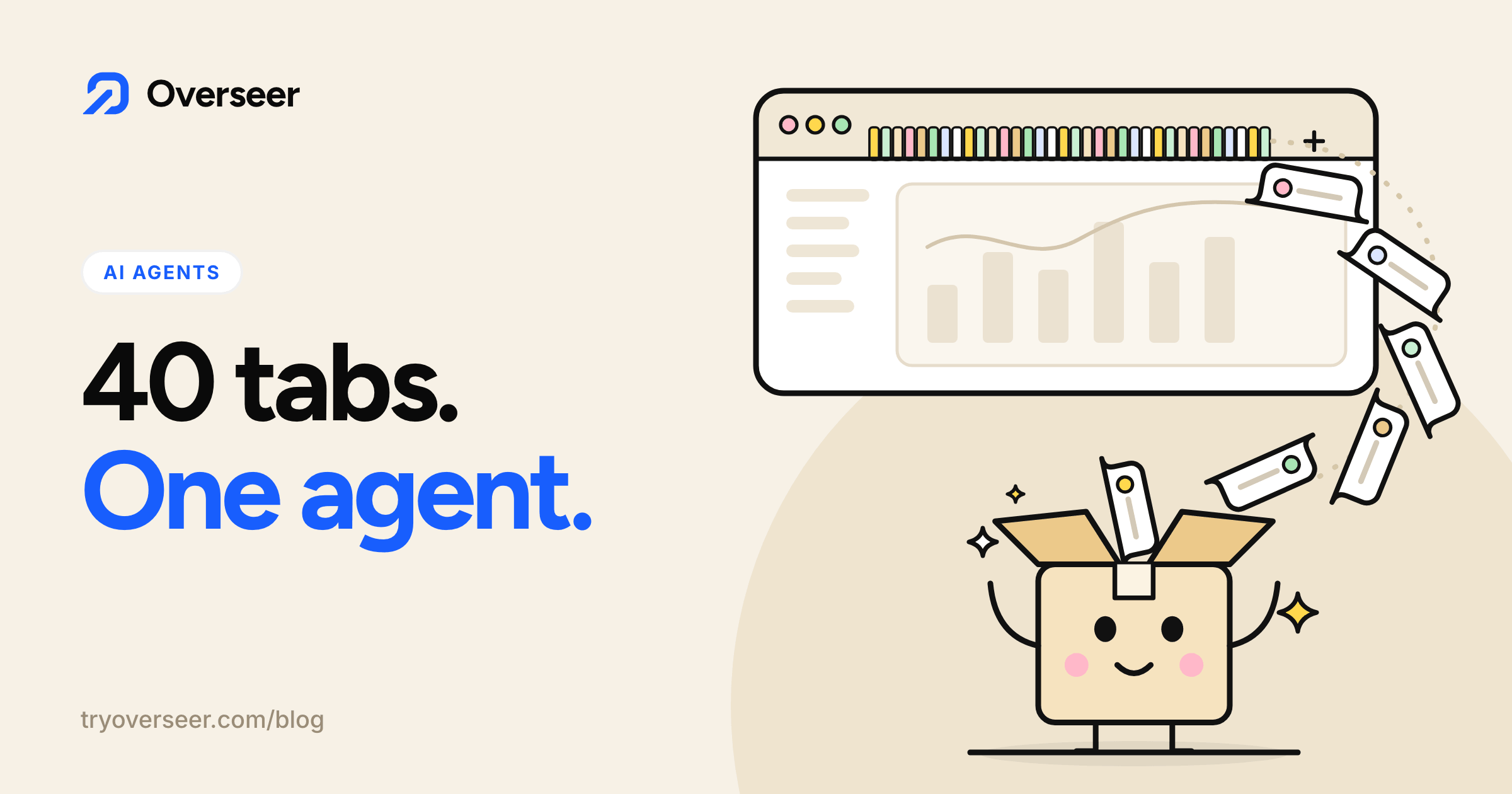
It’s 11:40 on a Tuesday night and you’re “just checking a few things.”
Count the tabs.
The Shopify admin. The theme editor, open on the product page you’ve meant to fix since August. Ads Manager. Events Manager, because the purchases in Ads Manager don’t match the orders in Shopify, again. Amazon Seller Central. Your email platform, with a campaign half-written. The reviews app. The helpdesk. WhatsApp Web, with fourteen customers asking where their order is. Instagram, where someone wants to know if the serum is safe for sensitive skin. Three versions of the same ad in a design tool. Analytics. A spreadsheet called Q4 plan FINAL v3. The shipping app. The bank. A thread with a freelancer. A video from your agency explaining why last week’s numbers were actually fine.
If you run a small ecommerce brand, you didn’t need to read that list. You were already counting your own.
Forty tabs is barely an exaggeration, and in most small brands all forty are open on the same laptop, in front of the same tired person.
That’s about to change, and the fix won’t be a better tab. The tabs themselves are about to stop being the place where the work happens.
How we got to forty tabs
Not long ago, opening an online store was an engineering project. Then the platforms made it easy. Today you can open a store in an afternoon, take payments by the evening and run ads to the whole world by the weekend.
What the platforms couldn’t do was run the business for you. That gap was filled, sensibly, by specialist software: an app for reviews, an app for email, one for upsells and another for subscriptions, a tool for creative, a tool for analytics, and a dashboard to reconcile the other dashboards. Each one solves a real problem. Each one was a good decision on the day you installed it.
Together they create a problem nobody chose: a business whose work is spread across dozens of systems that barely talk to each other, held together by the one person who logs into all of them.
Software was sold one problem at a time. Work doesn’t arrive that way. “Launch the new serum” isn’t an email problem or an ads problem or a page problem. It’s all of them at once, plus the Amazon listing, plus the customer who asks about sensitive skin on Instagram the morning after launch.
The real cost isn’t the subscriptions
It’s tempting to measure tool sprawl in monthly fees. The real costs are harder to see.
Attention. Every switch between tools costs a little focus, and a founder’s day is made almost entirely of switches. Hours disappear into finding the right tab, remembering the right setting and re-explaining context that the last tool already had.
The gaps between tools. Your ad platform doesn’t know you changed the product page. The page doesn’t know which ad sent the visitor. The email flow doesn’t know what the ad promised. Every tool optimises its own corner and nobody owns the seams, which is exactly where the money leaks. (One seam in particular deserves an essay of its own: ads and pages are one system.)
Decisions made on partial information. When the facts live in ten places, you decide using the three you had time to check. A creative gets switched off because its cost per purchase looks high, when the real problem was the page it was sending people to.
Add it up and you reach an uncomfortable conclusion. In most small brands, the founder is the integration layer. The most expensive middleware in the company is the person who should be working on the product.
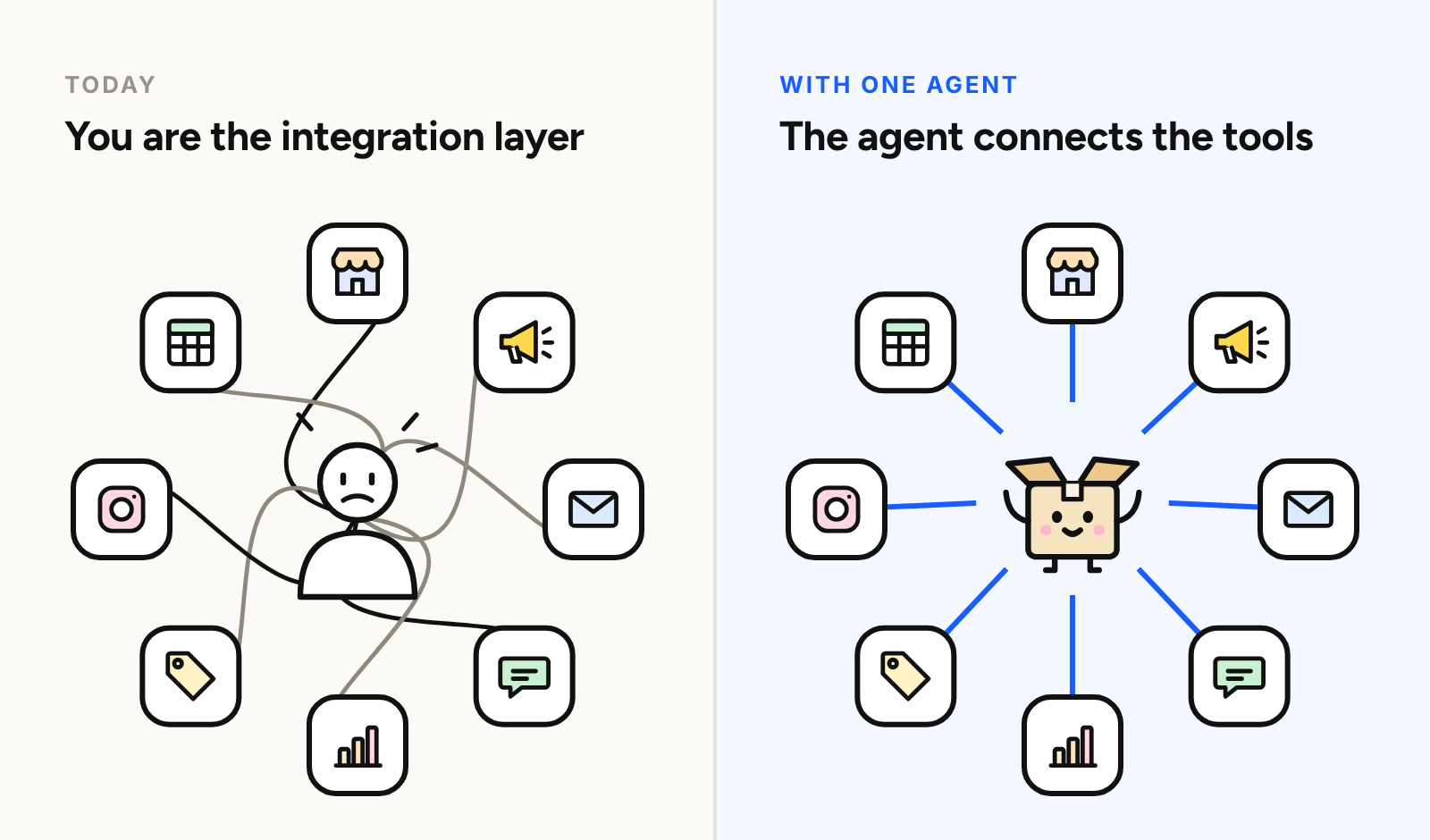
Copilots made the tabs smarter. They didn’t close any.
The first wave of AI in commerce mostly arrived as a button. Every tool added one: write this subject line with AI, generate this ad copy, summarise this report.
The buttons are useful. But look at what they left unchanged. You still open the tab. You still decide what needs doing, carry the context over from the last tool, press the button, check the output, paste it somewhere else and move on to the next tab. Forty tabs with forty assistants, each of which knows only its own tab, is still forty tabs.
The change that matters is from software you operate to software that does the work. A copilot waits for you to drive. An agent takes the destination, drives, and tells you how the trip went.
What changes when one agent does the work
Go back to that sentence: “We’re launching the new serum on Friday.”
In the forty-tab world, that’s the start of a project. Someone briefs a page. Someone writes the product description, then rewrites it for Amazon. Someone builds a campaign, chooses audiences and makes three creatives. Someone sets up the follow-up for shoppers who leave without buying. And on Monday, someone notices that the ad promises “fragrance-free” and the page never mentions it.
With one agent working across the store, the listings and the ads, the same sentence becomes a conversation. The page, the listing and the ads come from one understanding of the product, so they say the same thing. The cart reminder knows what the shopper left behind. When an ad underperforms, the agent can look at the page before blaming the creative, because it can see both.
That last part is the real argument for one agent over forty better tools. Fewer logins are nice. What matters more is that context which used to live only in the founder’s head finally lives somewhere that can act on it.
Should founders trust it?
At first, not completely. And they shouldn’t have to.
Trust in an agent should be built the way you build it with a new hire. Nobody gets the company card on their first day. You start with work that’s easy to check, look closely at the results and widen the remit as it proves itself.
A well-designed agent makes that easy. It shows you everything it did. It lets you decide what it can publish, send or spend on its own and what needs your approval. It asks when an instruction is ambiguous instead of guessing. Over a few weeks, your approvals turn into the rules it works by, and the share of the work that needs you keeps shrinking. (We go deeper on guardrails in your store should improve itself while you sleep.)
The point was never to take the founder out of the business. It’s to take the founder out of the tabs.
What founders do with the time back
Ask a founder why they started their brand and you will rarely hear “to reconcile attribution windows.” You’ll hear about a product they couldn’t find anywhere, a customer they understood better than anyone else, a conviction about how something should look and feel.
That’s the work an agent can’t do and shouldn’t try to: taste, product, community, and the relationships with customers and partners that make a small brand worth buying from. It’s also the first work to get squeezed when the evenings disappear into tabs.
Give a two-person brand an agent that carries the operational load and it can move like a team many times its size, launching faster, testing more and answering customers sooner. The founders aren’t working longer hours. The work that used to need a growth team simply doesn’t need one any more.
The brands that will win the next decade
Here’s our prediction. Within a few years, the default stack for a new brand will look far simpler than it does today: a storefront, a way to get paid and an agent. The specialist tools won’t vanish. They’ll become things the agent uses on your behalf rather than places you have to visit.
That matters for more than convenience. For two decades, the advantage of size in ecommerce has been headcount. The big brand has a person for every channel; the small brand has a founder with forty tabs. When an agent that any brand can afford does the work of those people, the advantage swings back to what small brands have always been good at: knowing their customers and caring more than anyone else.
That’s the future we’re building Overseer for: one AI agent for your Shopify store, your Amazon listings and your Meta ads, which you talk to in plain English and which does the work across all three. The plain-English part matters more than it sounds. We think it may be the biggest shift of all.
Tonight, close a tab. Before long, you won’t need to open most of them.