
Ads and pages are one system. We’ve been optimising half of it.
Return on ad spend is set by the ad and the page together, so brands that tune their ads and their landing pages separately are optimising half a system and paying for the gap between them.
Two brands sell the same serum. They run the same ad to the same audience with the same budget, and their cost per click is identical to the cent.
One of them makes money on that ad. The other switches it off on Thursday because “it stopped working.”
The difference isn’t the ad. It’s the few seconds after the tap. Brand A sends shoppers to a page that opens with the exact promise they just responded to: fragrance-free, made for sensitive skin, with the reviews to prove it. Brand B sends them to its homepage, where they have to find the product and then work out whether it’s the one from the ad.
Inside Ads Manager, both brands are looking at the same ad with very different results. Only one of them knows why.
ROAS has two halves
Return on ad spend looks like an advertising number. Write it out and it splits cleanly in two.
ROAS is revenue divided by ad spend. Revenue is clicks × conversion rate × average order value. Spend is clicks × cost per click. The clicks cancel out, and what’s left is a simple fraction:
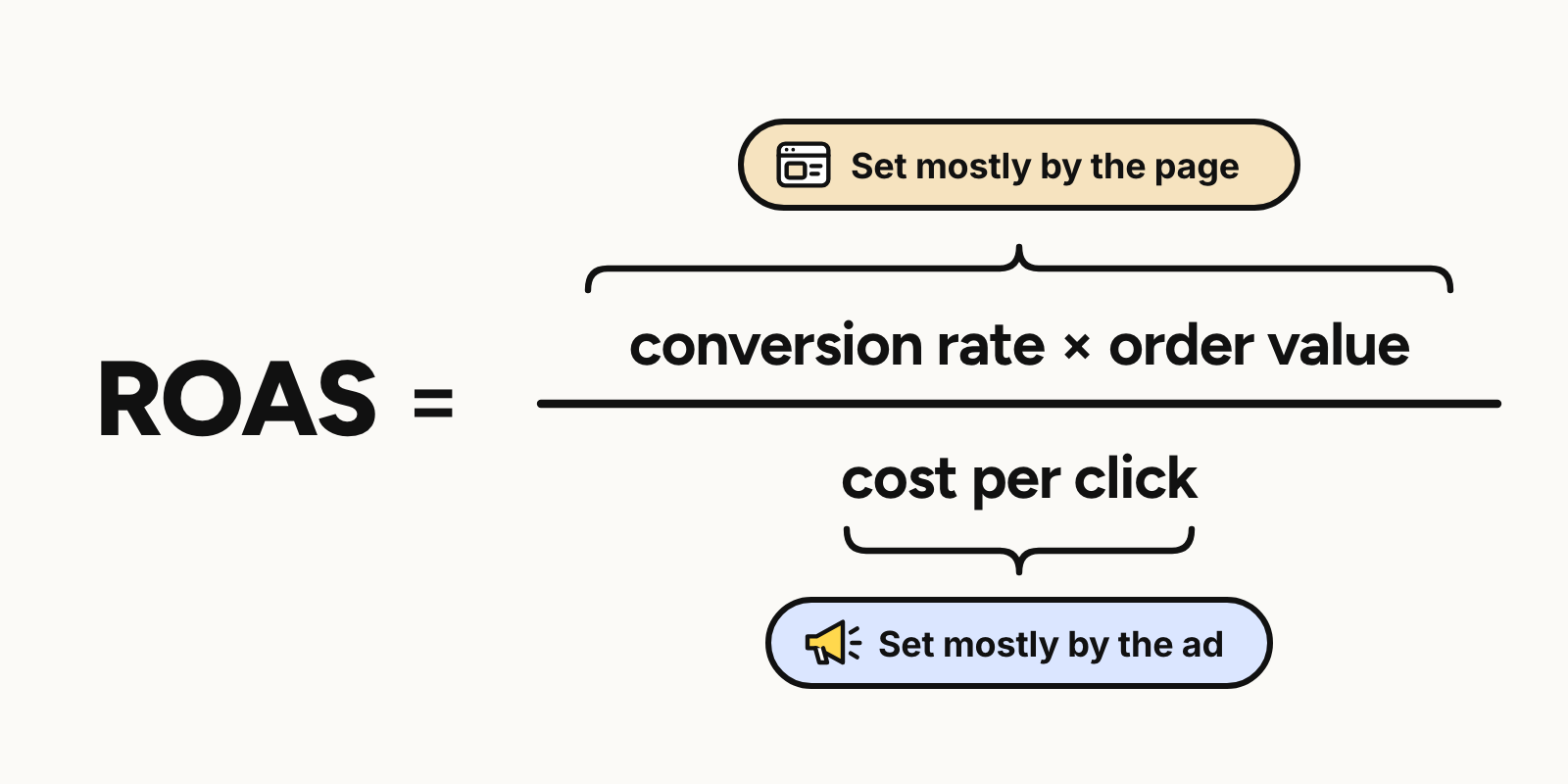
The ad mostly controls the bottom of that fraction: what you pay for each click, and who’s doing the clicking. The page mostly controls the top: how many of those visitors buy, and how much they spend. You can’t move ROAS without moving one of the two halves, and only one of them lives in your ad account.
Some round numbers make the point. Say you pay $1.00 per click, 2% of visitors buy and the average order is $60. Each click earns you $1.20, so your ROAS is 1.2.
Now improve the page so that 3% of visitors buy instead of 2%. Same ads, same audience, same cost per click. ROAS goes from 1.2 to 1.8, a 50% improvement.
To get the same result from the ad side alone, you’d need to cut your cost per click from $1.00 to about 67 cents. That’s a third off, in an auction where every other brand is trying to do the same.
Neither lever is easy to pull. But only one of them gets most of the attention, the budget and the weekly meeting.
The page trains the ad, too
There’s a second connection that’s easier to miss. Ad platforms optimise toward the results they can see. Meta’s delivery system learns from each purchase it’s told about, and its own guidance has long been that an ad set needs around 50 optimisation events in a week to exit the learning phase.
A page that converts better produces more of those events from the same traffic, so the algorithm gets more signal, learns faster and finds more people like your buyers. A page that converts badly starves it. When a brand says “Meta stopped finding buyers for us,” it’s worth asking whether the page ever gave it enough buyers to learn from.
The ad sends traffic to the page, and the page sends signal back to the ad. It’s a loop, not a relay.
Why we split them in the first place
If ads and pages are one system, why does almost everyone manage them separately?
Mostly because of how the tools and the industry grew up. Ads live in Ads Manager and pages live in the theme editor. They’re different products with different dashboards, and they’re often run by different people: a performance agency on the ads, a designer or conversion specialist on the store, and the founder in between, relaying messages.
Each side is judged on its own half. The ad team reports click-through rate and cost per purchase; the site team reports conversion rate. Both can hit their targets while ROAS falls, because nobody is measured on the handoff.
You’ve probably seen some version of these:
- The ad team finds a hook that doubles click-through: “the serum dermatologists recommend for redness.” The page leads with the brand story and mentions redness in the fifth paragraph. Clicks go up. Sales don’t.
- The site team tests a new product page and declares a winner. But the test ran on all traffic, most of which came from one ad with one specific promise, and next month the ads change.
- An offer goes live in the ads but not on the page, or on the page but not at checkout. Shoppers feel misled and leave.
None of these are failures of skill. They’re failures of structure: two halves of one system, optimised by people who can each see only their own half.
Where the money leaks
A click is a promise. The shopper tapped on a specific claim, image or offer, and the page has a few seconds to confirm they’re in the right place. Marketers call this message match. When it breaks, you’ve paid full price for a visitor you then turned away.
The common leaks are easy to spot once you start looking:
| What the ad said | What the page did | What the shopper did |
|---|---|---|
| Here’s one specific product | Landed on the homepage | Went looking, then gave up |
| Gentle on sensitive skin | Opened with a lifestyle banner | Couldn’t find the claim, left |
| 20% off your first order | Showed the full price | Assumed the offer was fake |
| Warm, playful creative | A cold, generic template | Wasn’t sure it was the same brand |
| Made for a phone, seen in a feed | Designed on a desktop | Gave up on a slow, cramped page |
Every row is a click you paid for. None of them shows up as a problem in your ad account. They show up as an ad that “doesn’t convert.”
How to optimise the whole system
You don’t need a reorganisation to start treating ads and pages as one thing. You need a few habits.
Start every campaign from one brief. The promise comes first: who it’s for, what it claims and what the offer is. The ad and the page are both written from that brief, at the same time, by people who can see both.
Give each big promise its own page. If you’re running three angles, say “gentle for sensitive skin,” “visible results in two weeks” and “the gift she’ll actually use,” you probably need three pages, or at least three versions of the first screen. That used to be too expensive for a small brand. When a page takes minutes to build instead of weeks, a page per promise becomes the obvious choice.
Judge creative by what happens after the click. Click-through rate tells you an ad is interesting. Revenue per click tells you it’s working. Look at both, and look at them by landing page.
Diagnose before you switch off. When an ad’s results drop, check the page before you kill the creative. When a page’s conversion rate moves, check what traffic it’s been getting before you credit or blame the design.
One system needs one brain
Those habits help. But they ask two teams using two sets of tools to coordinate constantly, and coordination is exactly what small brands don’t have time for.
That’s why we built Overseer as one AI agent that handles both halves: the Meta ads that bring shoppers in and the Shopify pages that turn them into customers, with your Amazon listings alongside. Because the same agent makes the ad and builds the page, they start from the same brief. And because it sees the ad, the click and the sale, it can look at both halves when results move instead of guessing which one broke.
Your shoppers never experienced your ads and your pages as two separate things. For them it was one moment: they saw something they wanted, tapped, and either found it or didn’t. It’s time we optimised for that moment as a whole.